
Criminal Cases in the Etowah County Courts
Etowah County is Alabama's Sixteenth Judicial Circuit. Etowah Circuit Criminal hears felony prosecutions and appeals from District Court and Gadsden Municipal Court misdemeanor cases. Etowah District Criminal hears most state-law misdemeanors, non-uniform citations, conservation cases, and preliminary proceedings in felony matters. District Court may accept some non-capital felony guilty pleas, but most felony cases move to Circuit Court if a grand jury returns an indictment.
The Circuit Clerk keeps Circuit and District case files at the Etowah County Judicial Building. A city ordinance case or municipal misdemeanor starts with the city court that heard it. The clerk's official municipal court directory lists Altoona, Attalla, Gadsden, Glencoe, Hokes Bluff, Rainbow City, Sardis, and Southside. Those separate courts matter because one countywide name search may not supply the city court's full file or warrant details.
Etowah County Criminal Court Divisions
The charge alone does not always reveal the right records counter. Circuit Criminal handles felonies after indictment. District Criminal keeps most misdemeanor files and the first phase of a felony. A municipal clerk keeps cases filed under that city's ordinances and jurisdiction. Appeals can move a municipal or District misdemeanor into Circuit Court, creating another layer of docket entries.
Etowah Circuit Criminal
801 Forrest Avenue, Suite 202
Gadsden, AL 35901
256-549-5437
Etowah District Criminal
801 Forrest Avenue, Suite 202
Gadsden, AL 35901
256-549-2150
Both county divisions use the Circuit Clerk's office in Suite 202. Public hours are 8:00 a.m. to 5:00 p.m. The adjacent county courthouse is at 800 Forrest Avenue, so a one-digit address mistake can lead to the wrong building.
How to Search Case Records
Etowah County criminal case searches have three main paths. The clerk's office provides a free name-search terminal. Just One Look sells on-demand case access, while Alacourt.com offers subscription, read-only trial court details and images. A case number is the strongest key. A name, date of birth, alias, filing year, county, and court division can narrow common names or separate two prosecution stages.
- Choose Circuit Criminal, District Criminal, or the correct municipal court based on the alleged charge and case stage.
- Search by the case number when known. Otherwise, use the party name and try documented aliases or spelling variants.
- Narrow the result with date of birth, filing year, case type, and Etowah County where the system offers those controls.
- Open the case detail and compare the court, charge, filing date, status, docket events, and disposition before relying on a match.
- Use the clerk's copy-request process for paper, certified, older, or archived material.
| Field Label | Type | Required | Notes |
|---|---|---|---|
| Case Number | Text | Route-dependent | Best identifier; Alabama numbers commonly encode division, year, and sequence. |
| Name or Party | Text | Alternative | The clerk terminal supports name search; try aliases and spelling variants. |
| Date of Birth | Date or text | No | Useful for narrowing; the clerk request form accepts DOB as identifying data. |
| County | Dropdown | Statewide search | Select Etowah when searching an Alabama trial court system. |
| Court or Division | Selector | No | Choose Circuit Criminal or District Criminal; city cases may require municipal court. |
Etowah Criminal Case Search Channels
Remote access and the courthouse terminal serve different needs. Just One Look is paid, case-by-case access. The prices viewed during Etowah research were $9.99 for a name or case-number search that included one case detail, and $9.99 for each extra case detail. A no-match response still counted as a search. Images were listed at $5 for the first 20 pages and $0.50 for each added page. Live pricing and sign-in prompts can change.
The free clerk terminal is the sound first choice for a person who can visit Suite 202. It searches the same Alabama trial-record family and lets a visitor identify the file before buying copies. Alabama's electronic filing information distinguishes AlaFile, Alacourt.com, and Just One Look. None should be described as a free, anonymous statewide criminal-history search.
The official Just One Look interface shows the remote route used for Etowah County criminal court records.
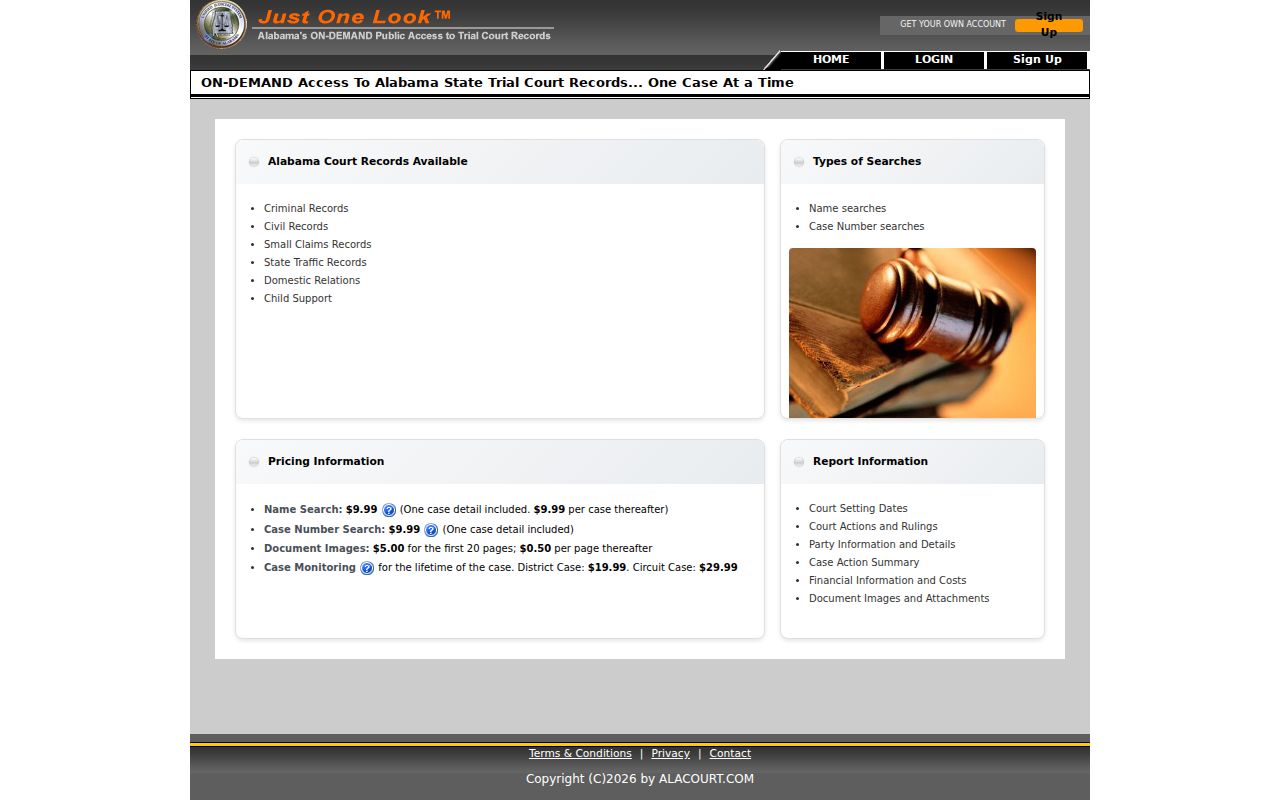
Its role is access to a trial court case detail, not a substitute for a certified clerk copy or an ALEA fingerprint history.
What the Case File Shows
An Etowah County court file centers on one prosecution. It may show the court and county, case number, filing date, status, parties and attorneys, charge description and statute, events, hearings, plea, disposition, sentence, costs, and available images. The docket is the dated event list. The charging paper states what was formally alleged. The final judgment and sentencing order are more useful than an early charge when the goal is to learn the outcome.
| Case Number & Court | Identifies the division, filing sequence, and Etowah court that owns the file. |
|---|---|
| Charging Document | States the filed accusation, charge language, and cited law. |
| Docket Entries | Lists filings, orders, appearances, motions, and other events by date. |
| Hearing Dates | Shows scheduled and completed proceedings, often with the assigned judge. |
| Disposition & Judgment | Records dismissal, acquittal, plea, verdict, or another final charge result. |
| Sentence & Conditions | Shows confinement, probation, fines, restitution, costs, and court-ordered terms. |
Online views may mask dates of birth, victim or minor details, and confidential filings. Document images also depend on the portal and account entitlement. For a filed document that is not shown, ask the clerk whether it is public and available as a copy.
Etowah Criminal Court Copy Fees
The Etowah Clerk's Request for Copies accepts the case name, case number, date of birth or alias, requested documents, contact details, and a choice of mail or pickup. The office advises that requests are processed in received order and may take up to 30 days because of minimal staffing. Mail requests should be precise and include a self-addressed stamped envelope. Wait for the clerk's estimate before sending a cashier's check or money order.
| Clerk Service | Researched Fee |
|---|---|
| Copies, 1 to 20 pages | $5 |
| Each page after 20 | $0.50 |
| Certification | $5 per file |
| Archived or microfilmed search | $25 per case |
A certified copy bears the clerk's formal certification. It is different from a screen print or an uncertified copy. Confirm current charges with the clerk before payment because posted schedules can change.
Stages of a Criminal Case
A prosecutor files a misdemeanor in District Court or the proper municipal court. A felony commonly begins with a warrant and District Court case. A preliminary hearing may test probable cause. Without one, the local court explanation says bind-over can occur after 30 days. The grand jury then decides whether to indict. An indictment creates a Circuit Court case, followed by arraignment, pretrial work, a plea or trial, disposition, sentencing, and any appeal.
Case flow: Charges Filed › Arraignment › Pretrial › Plea or Trial › Disposition › Sentencing
This flow describes the court record, not a promise that every case reaches each phase. A charge may be dismissed, declined, resolved by plea, or diverted where a program and prosecutor permit it.
Two Etowah Criminal Case Numbers
A closed District entry does not always mean an Etowah felony was dismissed. After bind-over and indictment, Circuit Criminal assigns a new number. The first docket may contain the warrant, initial appearance, bond work, and preliminary-stage events. The later Circuit file carries the indictment, arraignment, motions, plea or trial, final disposition, and sentence.
Search both divisions when the first file ends with language tied to grand jury review or transfer. Use the person's name, date of birth, alleged charge, and dates to match the two records. If an online result remains unclear, the Circuit Criminal desk at 256-549-5437 can explain where public records are kept, though clerk staff cannot give legal advice.
Note: A new Circuit number after indictment is a normal Etowah felony record path, not proof that two separate crimes occurred.
Etowah Criminal Docket Terms
Short docket labels can hide important differences. Read each term with the charge-level disposition and final order, not by itself.
- Arraignment
- The court proceeding where the formal charge is stated and a plea is entered.
- Docket
- The dated list of filings, hearings, orders, and other case events.
- Nolle prosequi
- The prosecutor's decision not to continue a charge at that time.
- Disposition
- The recorded outcome of a charge or case, such as dismissal, acquittal, plea, or verdict.
- True bill
- A grand jury decision to indict; a no bill means it declined an indictment.
A plea bargain is a negotiated resolution, while a sentence is the court-ordered result after guilt. These events can appear on different dates. The full docket and judgment provide the context needed to read them correctly.
Access & Restrictions
Code of Alabama § 36-12-40 supplies the baseline right to inspect and copy public writings, while Alabama Rule of Judicial Administration 33 governs electronic court access. Most adult Etowah criminal court files are open. Juvenile, youthful-offender, sealed, expunged, and otherwise confidential matters are not ordinary public records. Victim, minor, financial, and personal identifiers may also be withheld or redacted.
Use the free terminal or ask the clerk about an older public case that does not appear remotely. The clerk may confirm whether a public copy path exists but cannot explain legal strategy or eligibility for expungement. A person reviewing their own case should keep the certified judgment or disposition when accuracy matters, then compare it with any separate repository record.