
Running a Sex Offender Check in Etowah County
The official local route begins with the Etowah County Sheriff's Office OffenderWatch search. That sheriff-linked interface presents Alabama registry data in a local map and list format. It accepts a name for a person-based check, while an address, city, ZIP, county, and radius support a place-based check. A spelling variant or alias can matter, so a broad result should be narrowed with the photograph, physical description, address, registering agency, and offense fields rather than a name alone.
The Alabama Law Enforcement Agency registry program is the statewide source behind the public notification system. Local law enforcement registers and verifies people subject to the Alabama Sex Offender Registration and Community Notification Act, then sends current photographs, fingerprints, addresses, and reported changes to ALEA. Etowah County sex offender registry information is therefore one distinct record layer. It does not replace a court file, an arrest record, or a fingerprint-linked review of one's own Alabama criminal history.
Etowah County Registry Updates Reach ALEA
Registration starts with the local law-enforcement office responsible for the registrant. That office collects the facts Alabama law requires, verifies changes, and forwards them into ALEA's registry. ALEA says a registrant reports during the birth month and every three months after that. A profile can still depend on prompt self-reporting and local verification, which is why the public interface directs suspected address or exclusion-zone violations back to law enforcement.
Registry flow: Etowah law enforcement › ALEA Sex Offender Registry Unit › public OffenderWatch record.
This sequence helps when an Etowah County registry entry appears stale. Preserve the profile URL and the facts observed, then contact law enforcement instead of confronting anyone at the listed address. The public user does not edit a record. The registering office and ALEA handle verification and any lawful correction.
Note: A displayed address is a registry field, not an invitation to visit, photograph, question, or monitor the people who live there.
Searching the Alabama Sex Offender Registry
Use the official Etowah-linked interface for an Alabama search. The map and list views answer different needs: a name search tests a known spelling, while an address-and-radius search shows public entries around a location. Live radius choices can change, so select from the options displayed rather than assuming a fixed distance. The four steps below keep the search broad enough to find variants while reducing mistaken matches.
- Open the official OffenderWatch page linked by the Etowah County Sheriff's Office and read its conditions and misuse notice.
- Enter a name, or choose the address route and add city, state, ZIP, county, and a live radius option as needed.
- Switch between map and list views, then compare possible matches by photo, aliases, physical details, and registering agency.
- Open the full profile and read status, offense, address, vehicle, and registration data before drawing any conclusion.
| Field Label | Type | Required | Notes |
|---|---|---|---|
| Name | Text | No | Use a known spelling, then test aliases or variants if needed. |
| Address | Text | For proximity route | Starts a place-based search instead of a person-based search. |
| City / State / ZIP | Text and dropdown | As needed | Narrows the location around the entered address. |
| County | Dropdown | No | Select Etowah for county-focused results. |
| Radius | Dropdown | For proximity route | Use the current options shown in the live interface. |
| Map / List | View tabs | No | Changes how the same result set is presented. |
Etowah County Registry or NSOPW
An Etowah County sex offender check is the better first stop for Alabama-focused map and profile details. A separate National Sex Offender Public Website search queries participating public registries across jurisdictions. That national layer is useful when a person may have lived outside Alabama, when an offense arose in another state, or when a safety check covers travel beyond Etowah County.
The national search does not turn separate state rules into one uniform record. Open the source-jurisdiction profile and read its definitions, status, and limits. A missing national result is not proof that no restricted or nonpublic adjudication exists, and it should not be treated as a certified criminal-history response.
The official NSOPW interface shows the cross-state layer available to the public.
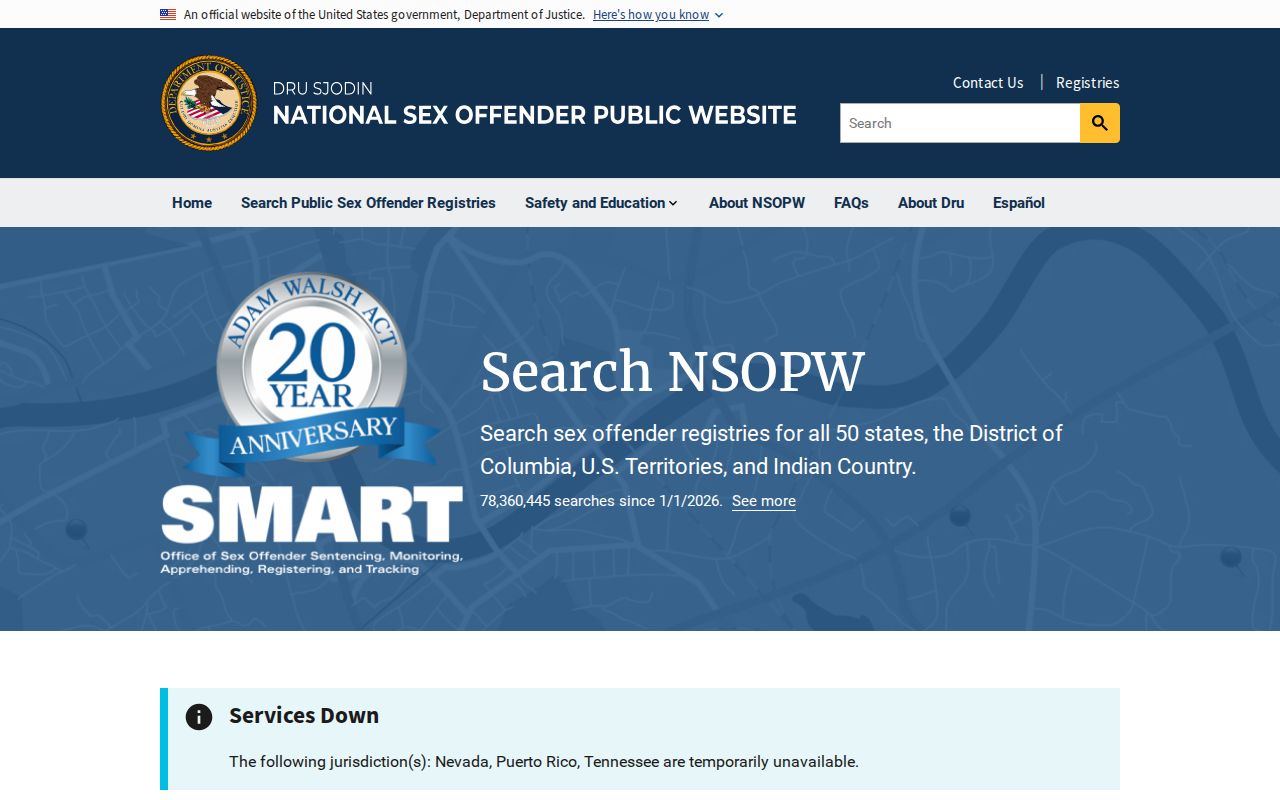
Its role is to widen geographic coverage, while the Etowah and Alabama source profile remains the place to interpret local registry facts.
Etowah County Registry Address Searches
An address-and-radius search serves a different purpose from a name search. It begins with a place, then displays public profiles that meet the live distance setting. Check the map against the list because pins can be close together, and open each profile before using the result in a safety plan. The profile, not the marker alone, supplies the registering agency, reported address, photograph, offense, and status.
Location results should be treated as a current public-notification snapshot. They do not prove that a listed person is present at a given moment, and they do not describe every person at the address. Recheck the official source when circumstances change. For a suspected address violation, record the specific conflict and report it to law enforcement instead of visiting the location.
What a Registry Profile Shows
A public profile groups identification, location, conviction, and compliance fields so readers can distinguish people with similar names. Read the whole set. A photograph and legal name can be paired with aliases, physical descriptors, scars, marks, tattoos, a registered address, vehicle details, offense jurisdiction, and the agency responsible for registration. The conviction date and statute describe the qualifying matter; they do not describe every allegation or every court event in a person's history.
| Name & Aliases | Legal name and other names made public for matching. |
|---|---|
| Photo & Physical Description | Current submitted image plus public descriptors, scars, marks, or tattoos where listed. |
| Registered Address | The reported residence and map or proximity information available through the interface. |
| Offense & Statute | Qualifying offense, legal citation, jurisdiction, and conviction date when published. |
| Vehicles | Vehicle details that Alabama law makes part of the public registry profile. |
| Registration Status | Compliance or other status, registering agency, and related registration data. |
Some sex-related adjudications are not publicly disseminated. ALEA identifies limits involving certain juvenile and youthful-offender matters, some out-of-state due-process situations, and specified first sexual-misconduct or indecent-exposure registration-only cases. Public absence therefore has a narrower meaning than a certified finding that no relevant record exists.
Etowah County Registry Data Corrections
Do not attempt a private investigation. Note the public profile, the date viewed, and the specific point that appears wrong. A possible address error, exclusion-zone concern, or noncompliance issue belongs with the Etowah law-enforcement agency responsible for verification. For an urgent threat, use emergency services. For a routine concern, use the sheriff's official contact channel or the registering agency shown on the profile.
ALEA explains that registrants supply current information and local law enforcement verifies and updates it. That division of work matters. The public can report an apparent conflict, but only the responsible office can check nonpublic records, document a violation, or correct the statewide entry. Avoid posting the allegation online because an unverified claim can expose uninvolved household members and can interfere with lawful review.
The ALEA registry explanations and reporting guidance show how state and local roles connect.
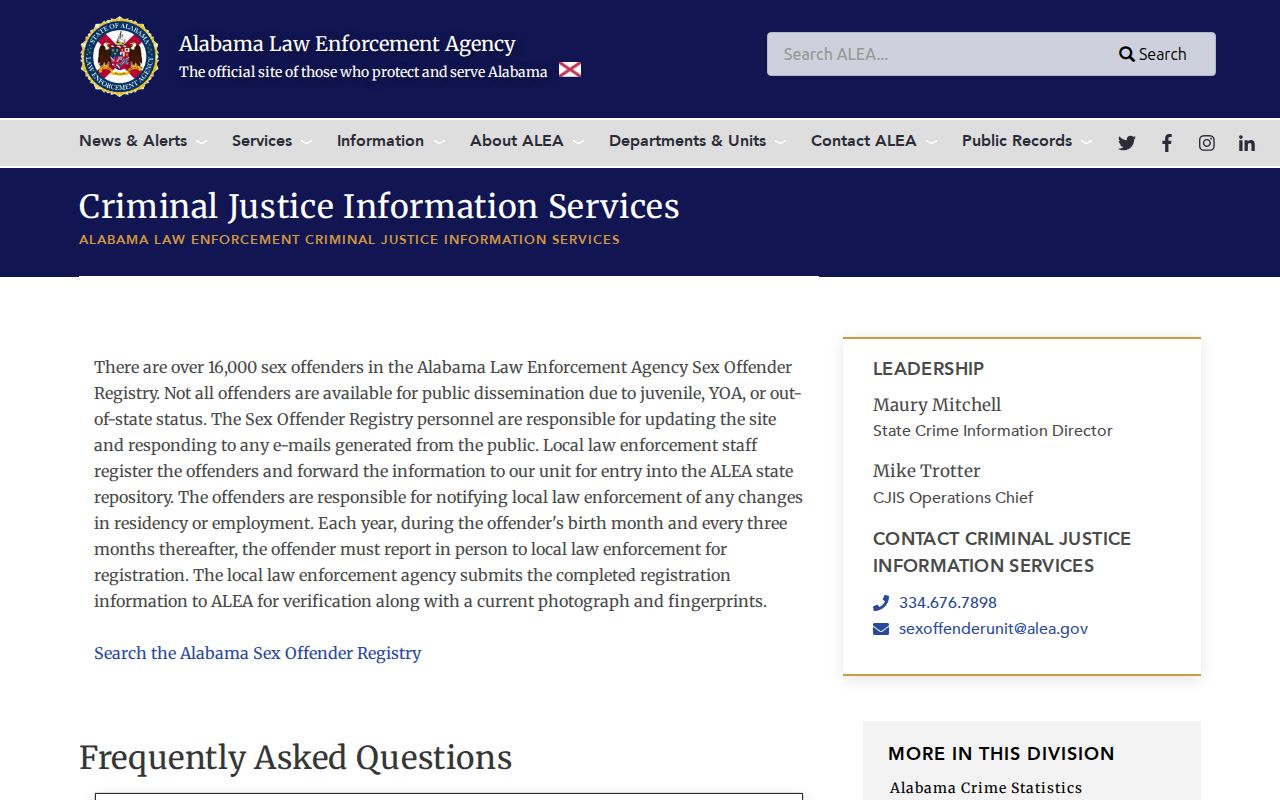
The guidance reinforces that suspected violations go to law enforcement, not to personal confrontation or crowd action.
Registration Requirements and Levels in Alabama
Alabama does not use a simple public Tier I, Tier II, and Tier III table. Duties under Title 15, Chapter 20A of the Code of Alabama turn on the qualifying offense, the person's legal category, and specific statutory conditions. Many adult requirements last for life and require quarterly in-person reporting. Other categories have distinct duration or public-disclosure rules. A federal tier chart should not be imported into an Etowah County sex offender registry check.
| Alabama category | Duration / visibility | Reporting duty |
|---|---|---|
| Many adult qualifying offenses | Lifetime duties commonly apply | Birth month and every three months thereafter |
| Certain juvenile or youthful-offender matters | Public disclosure may be limited or excluded | Depends on the specific statutory category and order |
| Certain out-of-state cases | Publication can depend on Alabama due-process requirements | Determined under ASORCNA for the actual case |
| Specified registration-only cases | Not every qualifying duty produces a public profile | Follow the offense-specific statute, not a generic tier |
The exact conviction and category control. For example, a person convicted of an offense against a child under twelve faces a specific rule against loitering on or within 500 feet of listed child-focused places. Residence and work limits also depend on the statute. The profile and the current Alabama Code should be read together when a precise duty matters.
Etowah County Registry Results Have Limits
A registry result answers whether Alabama publicly lists a person under its community-notification law. It does not provide the full Etowah County court case, the investigating report, or every criminal-history event. To understand a named conviction, use the court file for charges, docket events, plea, disposition, and sentence. The broader Etowah County criminal court case record can show that prosecution context without treating the registry as a general background report.
The distinction also protects sound decisions. A map marker may show a registered address, but it does not prove current presence at a specific moment. A status field may signal compliance or another registry condition, but it does not authorize surveillance. Use registry facts for reasonable safety planning and verify concerns with the public agency that maintains the record.
Note: Restricted juvenile, youthful-offender, and other nonpublic records will not become visible merely because a broad name search is used.
Lawful Use and Community Notification
Registry data supports public awareness, family safety planning, and lawful community notification. It should be used with care. Match more than a name, read the offense and status fields, and rely on law enforcement for compliance questions. The ALEA registry forms and acknowledgements provide the official state context, while OffenderWatch supplies the Etowah-focused public search.
Community awareness does not grant power to punish. Do not threaten, follow, contact, shame, or organize action against a listed person or household. Do not trespass or publish added private details. If a child-safety or address concern appears credible, report the precise facts to law enforcement and let the agency apply Alabama law.
Registry misuse is a crime: Alabama's official registry warning prohibits using this information to harass, threaten, or intimidate a registrant, a registrant's family, or another person. Misuse can lead to criminal prosecution or civil liability under Code of Alabama Title 15, Chapter 20A.
False pretenses and unauthorized criminal-history dissemination also carry legal risk under Code of Alabama § 41-9-601. The safe rule is plain: use public registry data for awareness, confirm it at the official source, and send suspected violations to the responsible agency.