
How to Check Criminal History in Etowah County
No single Etowah County search returns every kind of criminal record. Start with the event being checked. A prosecution belongs in the Circuit Clerk's court data, while a recent custody question belongs in the sheriff's roster. The free public terminal in the clerk's Suite 202 office supports name searches. Just One Look offers paid, case-by-case access from outside the building, and Alacourt.com serves subscribers. City reports stay with the police department that wrote them.
Prepare a full name, date of birth, aliases, spelling variants, an approximate date, and any case or booking number. Those details help separate similar names and can reveal both an early District Court case and a later Circuit Court case after a felony indictment. A result is a lead, not a final identity match. Read the court, filing date, charge, status, and disposition before relying on it.
- Choose the court file, jail booking, police report, registry, or fingerprint history that fits the question.
- Search the official channel with the name, case number, date of birth, or booking date it accepts.
- Check identifiers, the responsible agency, and dates before treating the result as a match.
- Open the case or booking detail and note that filed charges may differ from arrest charges.
- Request a certified court copy or your fingerprint-confirmed ALEA history when an official record is needed.
Three Etowah Criminal Record Counters
The phrase "the courthouse" can send an Etowah County visitor to the wrong door. County government is at 800 Forrest Avenue. The William H. Rhea III Judicial Building, where the Circuit Clerk keeps Circuit and District case records, is at 801 Forrest Avenue. The Etowah County Sheriff's Office and Detention Center are at 827 Forrest Avenue. Court copies come from Suite 202 at 801, not from the jail counter at 827.
The clerk is open from 8:00 a.m. to 5:00 p.m. and lists 256-549-2150, while Circuit Criminal lists 256-549-5437. The sheriff's main and inmate-information line is 256-546-2825. Gadsden city reports are farther away at 1511 Campbell Avenue. That Records Division moved into the Municipal Court Complex in May 2025, so a Gadsden police report and an Etowah County court file now begin at different sites.
Etowah Circuit Clerk
801 Forrest Avenue, Suite 202
Gadsden, AL 35901
256-549-2150
Monday through Friday, 8:00 a.m. to 5:00 p.m.
Etowah County Sheriff
827 Forrest Avenue
Gadsden, AL 35901
256-546-2825
Lobby hours Monday through Friday, 8:00 a.m. to 4:00 p.m.
Gadsden Police Records
1511 Campbell Avenue
Gadsden, AL 35901
256-549-4500
Monday through Friday, 8:00 a.m. to 4:30 p.m.
Official Alabama Background Checks
The Alabama Law Enforcement Agency Criminal Justice Information Services Division maintains Alabama's fingerprint-linked criminal history repository. The public cannot run an unrestricted name check through ALEA. The Alabama Background Check System is restricted to users qualified by statute. For ordinary self-review, a person submits classifiable fingerprints, photo identification, the signed application, and payment to ALEA.
The official ALEA background-check page explains why the fingerprint product differs from a court-name search. A county court search can show Etowah County prosecutions, but it is not a statewide rap sheet. ALEA's self-review fee is $25, with extra copies at $5 each. Gadsden Police offers a local fingerprint service for $10 on Tuesdays and Wednesdays during its published morning and afternoon windows. Call first to confirm card needs.
The ALEA source page shows the state channel used for an official self-review.
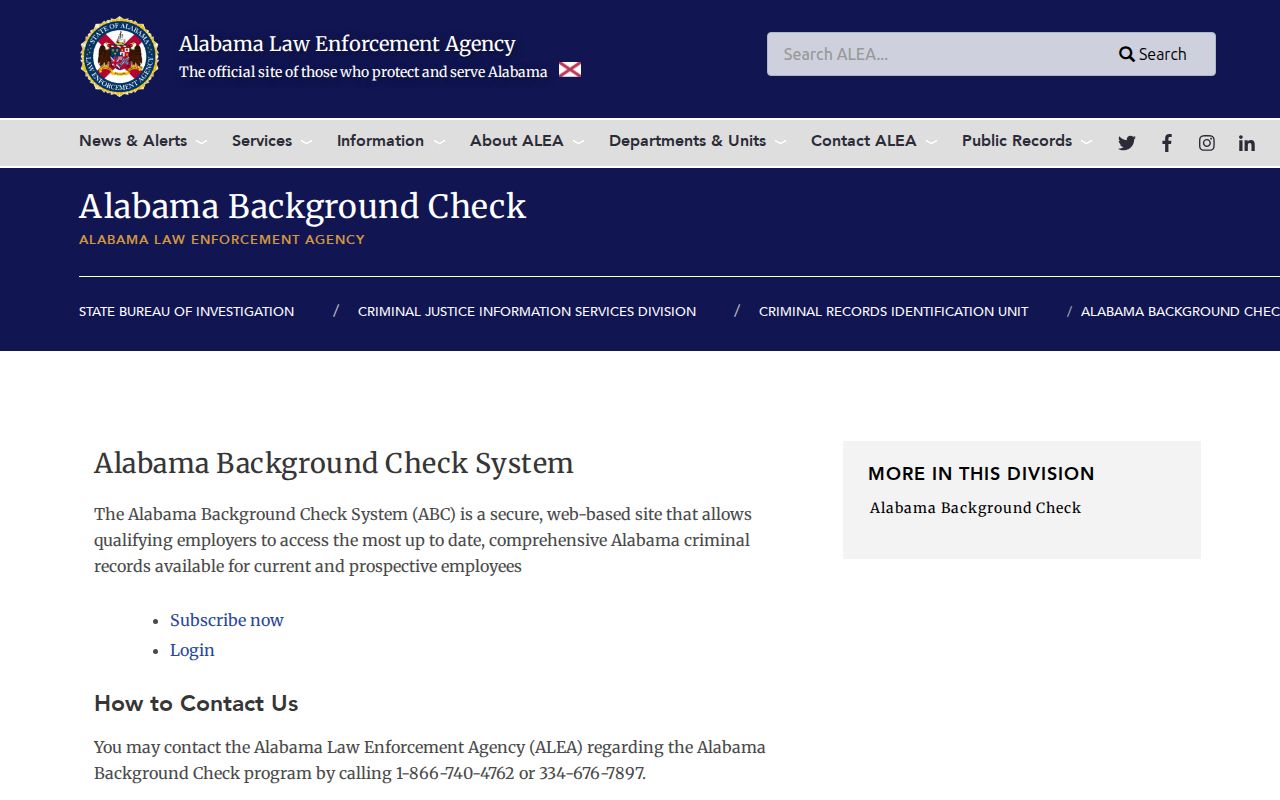
Its fingerprint and identity steps help link the request to the correct Alabama record rather than to a similar name.
| Service | Cost | Key requirement |
|---|---|---|
| ALEA self-review | $25 | Authorized law-enforcement fingerprints and photo ID |
| Extra ALEA copy | $5 | Requested with the self-review |
| Gadsden fingerprinting | $10 | Photo ID and the published service window |
ALEA Etowah Record Self-Review
An Etowah County resident completing an ALEA self-review must fill in current address, aliases, date of birth, sex, race, driver's license details, and contact information. The application also calls for a photo ID, a classifiable fingerprint card, and either two witnesses or a notary. Payment must be a cashier's check or money order. The packet may be mailed to ALEA Records and Identification Division in Montgomery or delivered to its South Ripley Street entrance.
The repository image from ALEA Criminal Justice Services provides context for the state unit that receives arrest fingerprints and court outcomes.
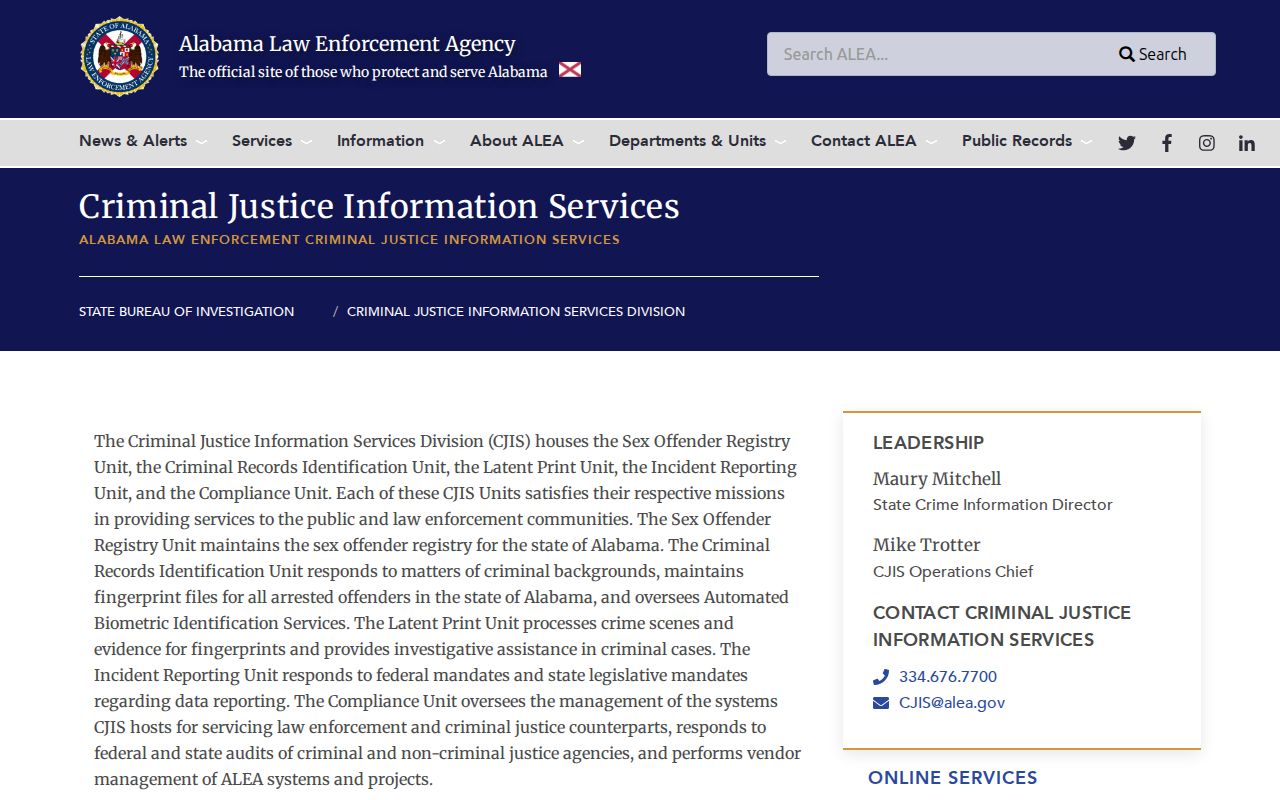
Self-review is the sound route for checking one's own statewide, fingerprint-linked history and then challenging a missing or mismatched entry.
For a federal self-check, the FBI Identity History Summary is also subject-only and fingerprint based. It does not replace the Etowah clerk's live file or ALEA's Alabama product. The narrow purpose matters: use the court file to understand one prosecution, the jail roster to locate current custody, and the repository history to review the statewide record attached to one's fingerprints.
Types of Criminal Records
Each Etowah County criminal record begins with a different office. An arresting officer creates an incident or arrest report. The Detention Center produces a booking entry at intake. The Circuit Clerk or a municipal clerk opens a prosecution file. ALEA links fingerprint arrest cycles with reported court outcomes. Courts and serving agencies track warrants, while separate systems cover prison custody, supervision, and public registry duties.
These products overlap, but none can safely stand in for all the others. A roster shows custody, not the officer's full narrative or the final court result. A court file shows charge and disposition events, not a complete statewide history. The registry is a public-notification system for people subject to Alabama's specific registration law, not a general list of convictions.
- Booking
- Jail intake that records identity, charges, bond, and custody status.
- Docket
- The court's dated list of filings, hearings, orders, and other case events.
- Disposition
- The outcome recorded for a charge or case, such as dismissal, plea, verdict, or acquittal.
- Capias
- A court writ that directs a person to be taken into custody.
- Expungement
- Court-ordered record relief under Alabama Title 15, Chapter 27.
Etowah Jail and Prison Records
The sheriff's roster chooser separates Current Inmates from the 48 Hour Release list. Current Inmates addresses custody now. The release view is limited to the preceding 48 hours. A blank result does not prove that no arrest occurred, since a person may have left that display window or been held elsewhere. JAIL View offers name, date, custody, charge, bond, and booking details, with a warning that charges and bail can change.
The Etowah County Sheriff's Office website is the official entry point for those custody tools.
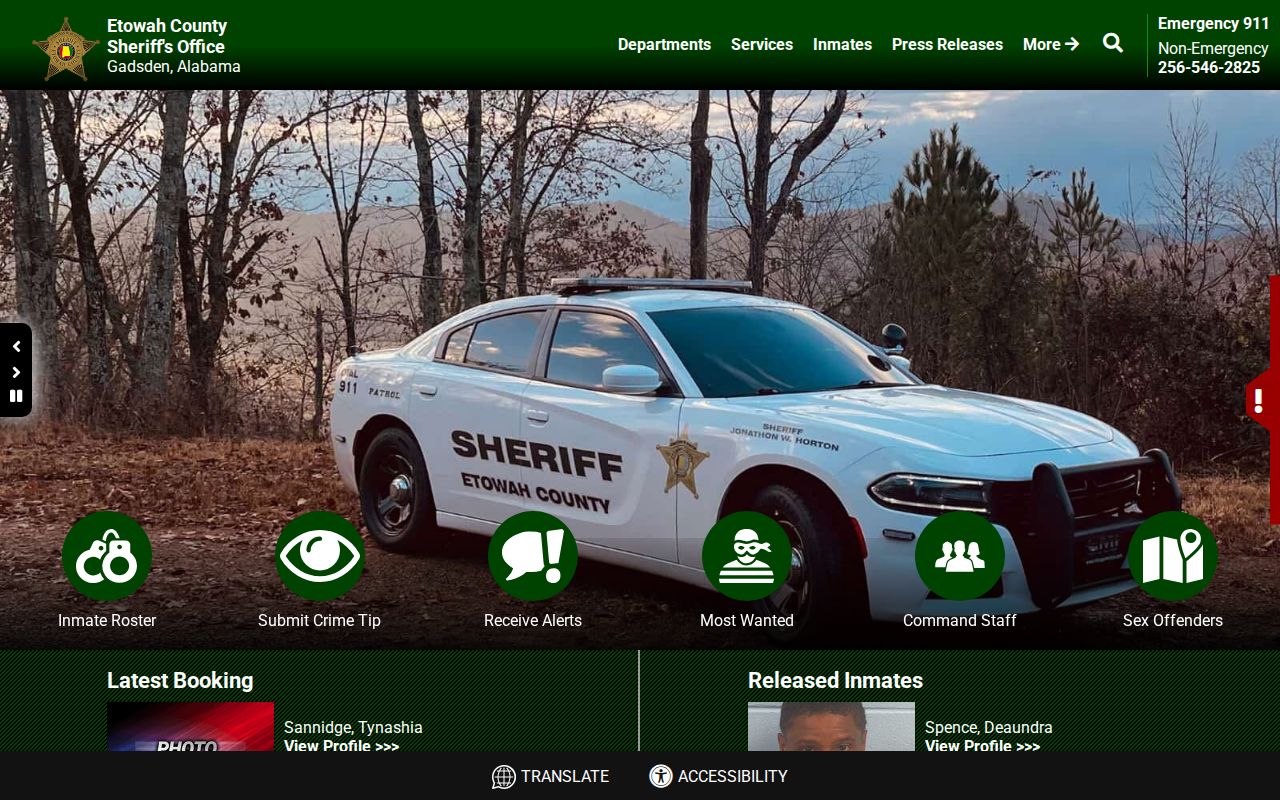
The sheriff's app also carries news, tips, alerts, and interactive safety features, but its store description does not support calling any feature an app-only warrant search. Once a person is serving a state-prison sentence, switch to ADOC Inmate Search. For federal custody from 1982 onward, use the Federal Bureau of Prisons locator.
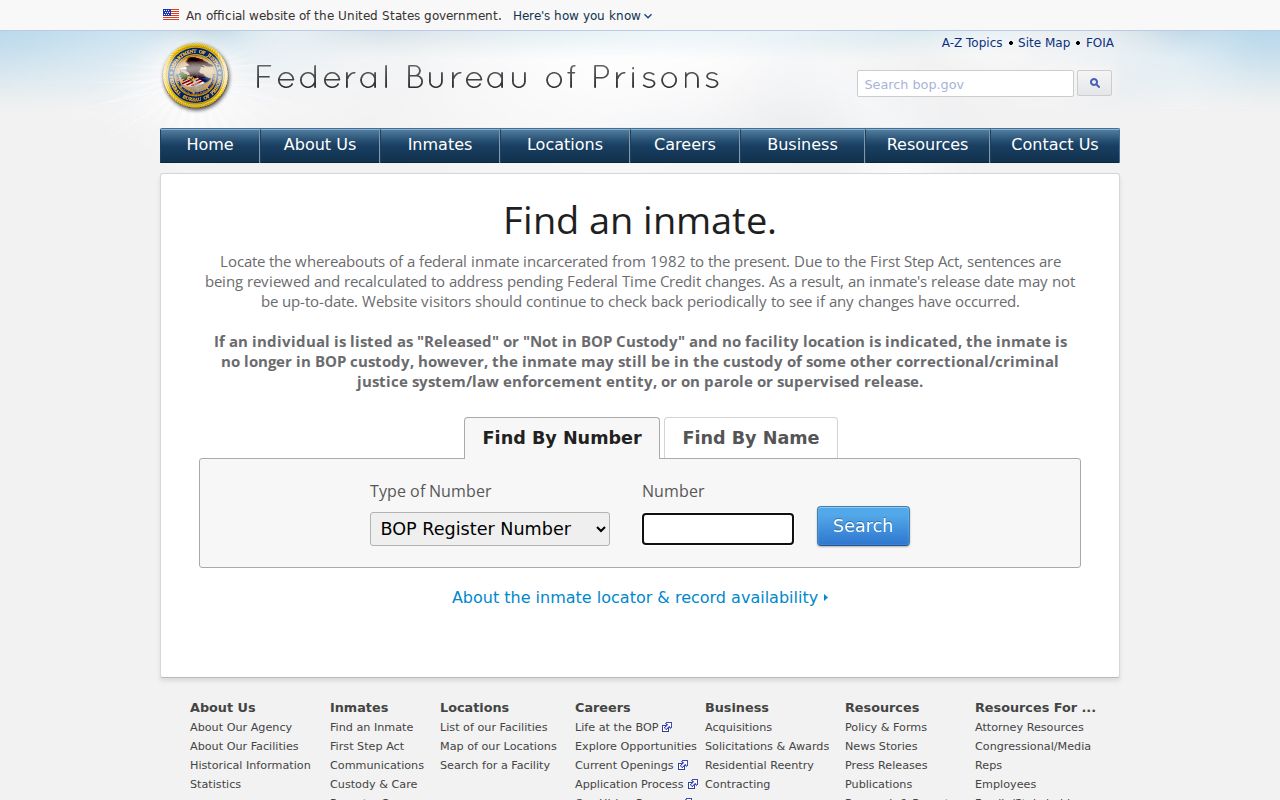
The federal locator is a separate layer and should not be read as an Etowah County booking or Alabama prison list.
What an Etowah County Criminal Record Shows
The fields depend on the record. A court file focuses on one prosecution. It can identify the case number, division, filing date, status, parties, attorneys, charges, statutes, docket dates, plea, disposition, sentence, and financial assessments. A booking entry instead centers on intake time, booking number, agency, alleged charges, bond, release, and present custody. ALEA history organizes fingerprint-linked arrest cycles with reported outcomes.
Read the source date and status beside each field. Booking charges can change after review by the prosecutor or grand jury. An early District Court felony number may end when the matter binds over, while a new Circuit Court number appears after indictment. That is not proof the charge vanished. The later court docket and final judgment give the prosecution outcome.
| Name & Identifiers | Legal name, aliases, date of birth, and source-specific identity fields. |
|---|---|
| Arrest / Booking Data | Arresting agency, booking number and time, custody status, charge, bond, and release data. |
| Charges & Statutes | The alleged offense, legal citation, and felony or misdemeanor classification where shown. |
| Disposition | The recorded result for each charge or the case, which may differ from the arrest allegation. |
| Sentence | Custody, probation, restitution, fines, costs, and other terms ordered by the court. |
| Custody / Supervision | Jail, prison, release, probation, or parole context from the office responsible for that status. |
How Etowah Criminal Records Flow
An Etowah County arrest can create several records in sequence. The police or sheriff writes the report. Detention staff book the person, take fingerprints, and enter charges and bond. District or municipal court begins the first case events. A felony normally moves to Circuit Court after grand-jury action and receives a new case number. Courts then report dispositions to ALEA's Criminal History Repository.
Record flow: Arresting agency › Etowah Detention Center › District or municipal court › Circuit Court when indicted › ALEA repository.
A delay or missing fingerprint match can make ALEA history differ from the live clerk file. ALEA reported processing hundreds of thousands of fingerprint cards and tens of thousands of court dispositions statewide in fiscal year 2025, which shows why matching and reporting are separate steps. When an entry looks wrong, compare the certified Etowah disposition with one's certified ALEA self-review before requesting a correction.
Public Access Laws
Alabama access is record-specific. Most adult court files may be inspected at the clerk, but juvenile, youthful-offender, sealed, and other confidential material stays outside ordinary public results. The sheriff may publish custody data while withholding protected investigation, victim, medical, or security details. ALEA's fingerprint repository is not an open public name database. A narrow request to the correct custodian produces better results than a demand for every criminal record tied to a name.
Key Alabama authorities:
Code of Alabama § 36-12-40 gives the baseline right to inspect and copy public writings, subject to exceptions.
Code of Alabama § 41-9-601 governs criminal-history information and penalizes access or disclosure by false pretenses or without authority.
Alabama Rules of Judicial Administration, Rule 33 supplies the electronic court-record framework while excluding sealed and confidential material.
Code of Alabama Title 15, Chapter 27 sets the state's expungement process and effects.
A standard public-record request under Alabama's 2024 procedure should be acknowledged within ten days, then fulfilled or substantively denied within fifteen business days after acknowledgment. More demanding requests take longer. The sheriff publishes no fixed report fee chart or guaranteed turnaround, so confirm the custodian and current charge before sending payment.
Etowah Warrant Record Checks
Etowah County has no comprehensive official online warrant database. The sheriff's Most Wanted page is selective, not a full list. County felony and state misdemeanor warrants may require calls to the sheriff and Circuit or District clerk. Gadsden municipal warrants go through the Warrant Office at 1511 Campbell Avenue, 256-549-4595 or 256-549-4596. Southside advertises warrant checks by phone, and other city bench warrants belong with the issuing municipal court.
If an unsolicited caller demands payment for a warrant, stop and verify. The Etowah Circuit Clerk posts a specific scam warning and directs callers to 256-549-2174. To resolve one's own warrant, confirm the issuing court, ask what appearance or bond step is allowed, complete that step, and then verify that both the court and serving agency cleared their systems.
Note: An arrest warrant, bench warrant, and search warrant serve different legal purposes, and sealed or unserved matters may not be public.
Sealed, Expunged, and Restricted Records
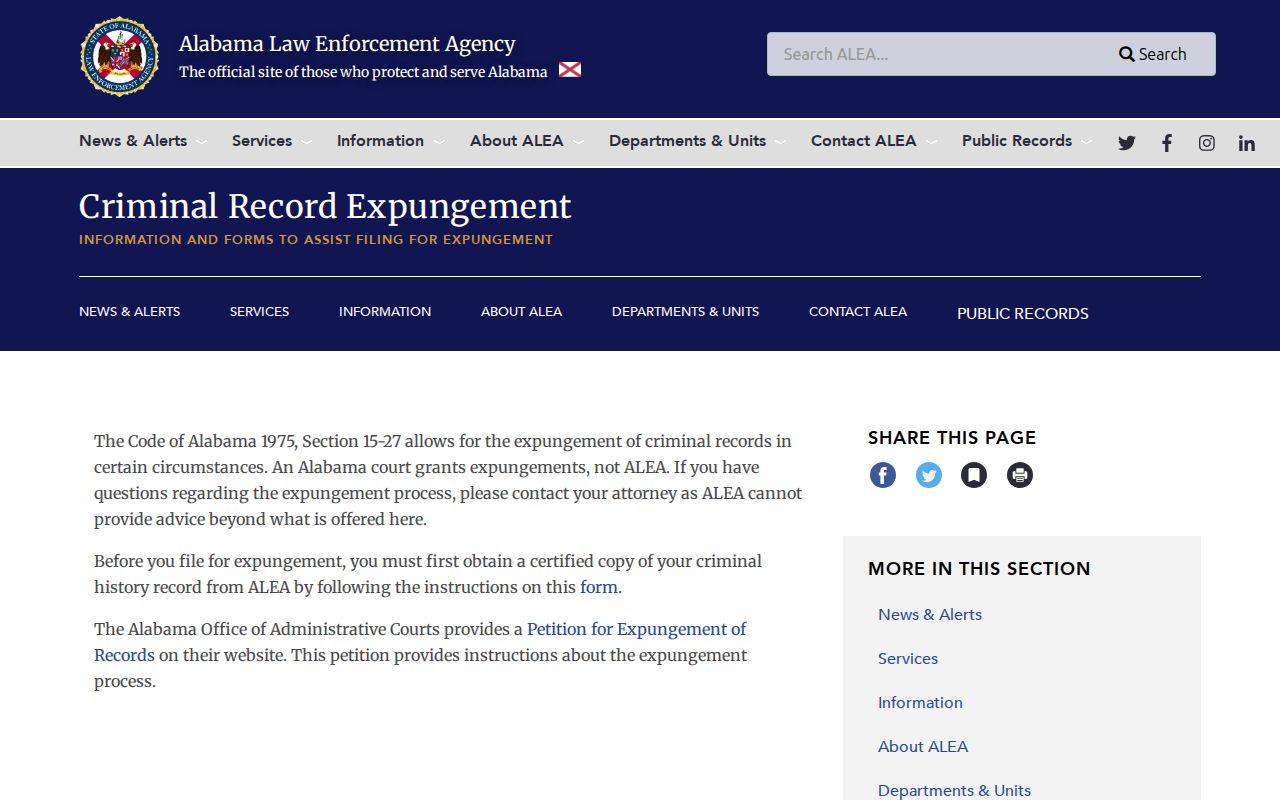
Etowah County expungement is a court process under Alabama Title 15, Chapter 27. It is not a request for ALEA to delete an entry on its own. Begin with a certified ALEA criminal history and certified Etowah court dispositions. Check eligibility and the waiting rule for each outcome, then use the current AOC Form CR-65. Petitions involving Etowah District Court or any municipal court in the county are filed with Circuit Criminal in Suite 202.
The Etowah administrative filing fee is $500. The prosecutor has 45 days to object. If an objection is filed, a hearing should be set no sooner than 14 days later. Without an objection, the judge may rule with or without a hearing, and the clerk says to allow up to 60 days for notice of the ruling. A pardon from ABPP is distinct from expungement and does not automatically erase the court file.
The ALEA expungement overview explains the agency's role after a court acts.
A certified final order is useful when asking the clerk or ALEA to correct an official source that still displays cleared material.
Gadsden Criminal Records Moved
Gadsden moved its Police Records Division to 1511 Campbell Avenue on May 12, 2025. The Municipal Court Complex now places crash and incident report copies near the city court and magistrate or warrant function. The public counter is open weekdays from 8:00 a.m. to 4:30 p.m. Report copies cost $10, paid by cash or check, and photo identification is helpful.
This city channel should not be confused with the Etowah County clerk or jail. Gadsden Police keeps its narrative report. A city prosecution remains in Municipal Court, while a state-law or felony case routes through District or Circuit Court. A Gadsden arrest commonly appears in the Etowah Detention Center roster, but the roster cannot replace the police report or the later court outcome.
Criminal Records by City in Etowah County
Etowah County's three largest incorporated cities keep distinct police and municipal court channels. Gadsden has a centralized report and municipal court complex. Rainbow City provides police report rules and a city court at Rainbow Drive. Southside relies on police and court counters and has a local Pre-Trial Intervention Program. County custody and state-law prosecutions may move beyond those city offices, so each city path must be followed to its Etowah court or jail layer.
Gadsden Criminal History
33,086 residents · Police records and municipal court share the Campbell Avenue complex.
Rainbow City Criminal History
10,349 residents · Police report copies and municipal cases start on Rainbow Drive.
Southside Criminal History
9,633 residents · Police, municipal court, warrant, and PTIP channels are city-specific.
A city police report does not replace the county booking or court record. Follow the city guide for the local report first, then use the Etowah County jail or court channel when custody or prosecution moved beyond the city.
Etowah Probation and Parole Records
Adult probation and parole are state-run through the Alabama Bureau of Pardons and Paroles, while the Etowah court file remains the public route to the sentence itself. There is no public county probation roster. Start with the disposition and sentencing order, then use ADOC data for prison or release context and the ABPP Gadsden field office for information it may lawfully confirm.
The ABPP source page identifies the statewide supervision and parole authority.
Officer notes, treatment records, risk assessments, and other sensitive supervision material are not ordinary public files.
Probation and parole do not mean the same thing. A judge imposes probation as part of a sentence. Parole follows a Board decision to release a person from prison under supervision. An alleged violation can generate a report, warrant, hearing, and new order, so the current court docket may be needed to understand whether supervision continued, changed, or was revoked.